Tag lines
Cat food: Would you feed your children mysterious animal by-product from a can? Of course not. So why would you give it to your cat?
Children’s hospital: A place where a Texas-sized facility perfectly meets the needs of even the smallest patients: Texas Family Hospital.
Albuquerque, NM: The adventure you didn’t know you needed is waiting for you.
VisitDFW: June 2019-August 2019
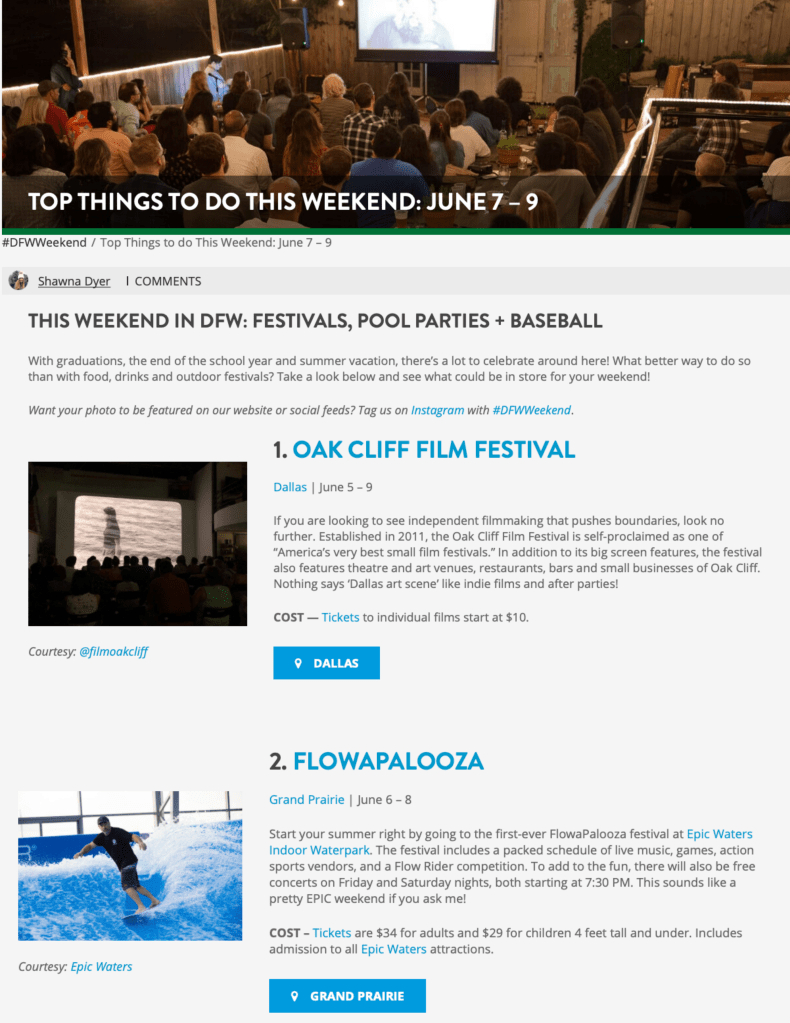
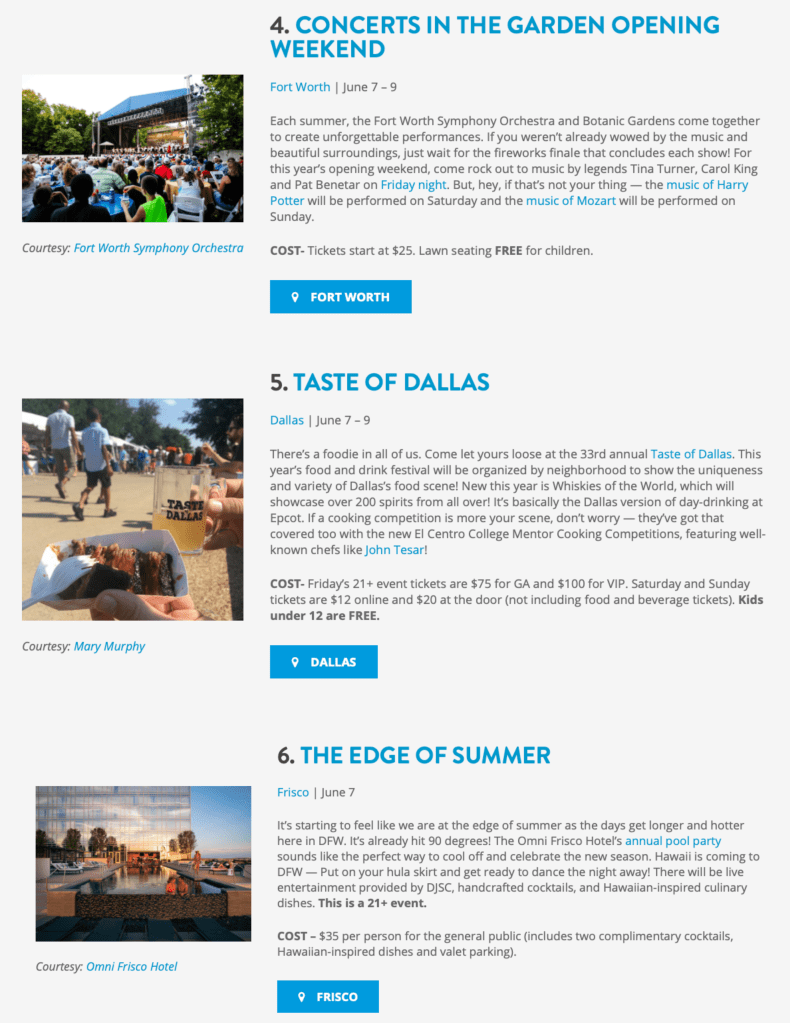
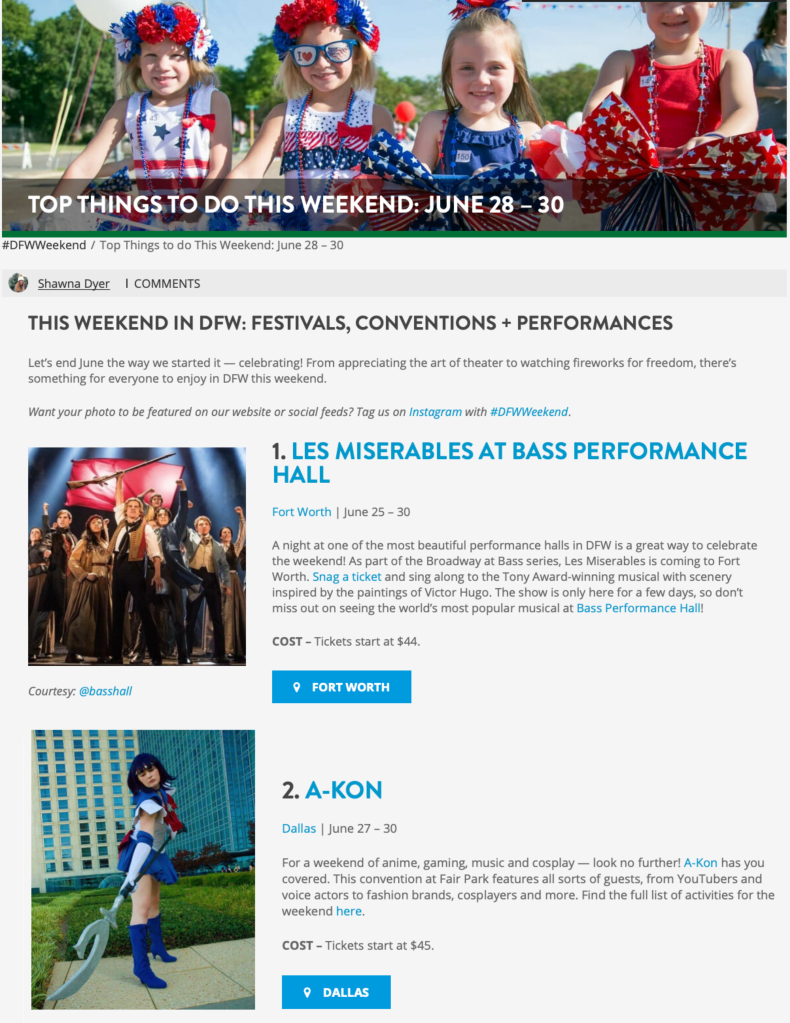
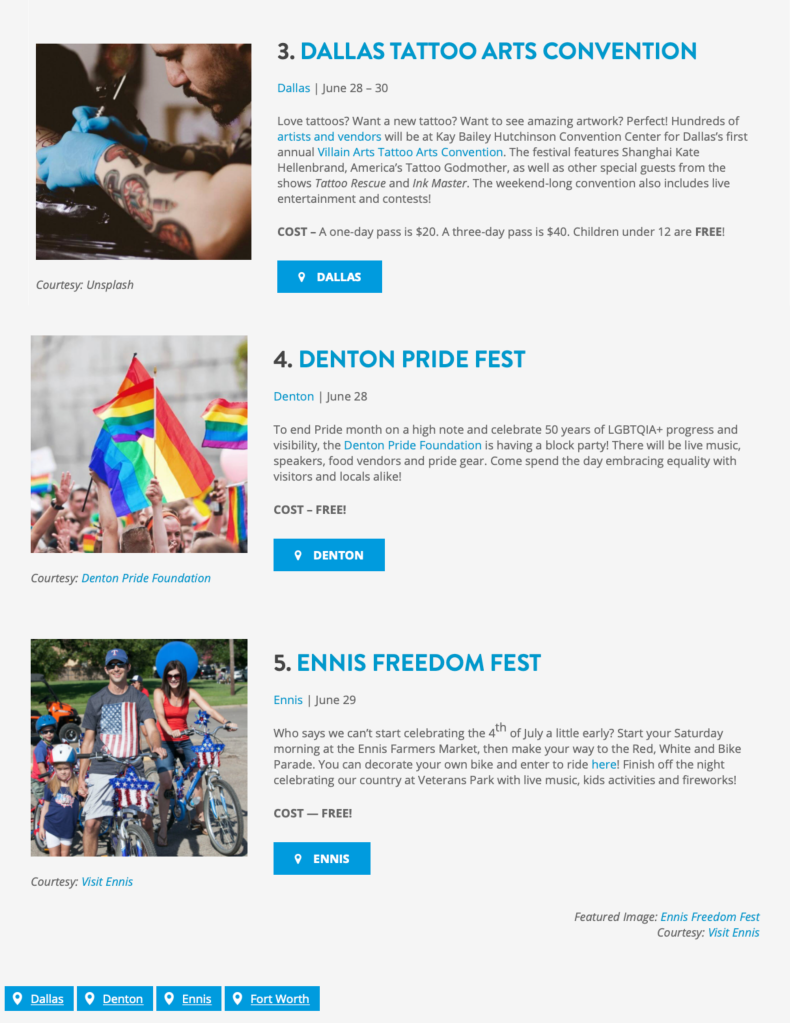
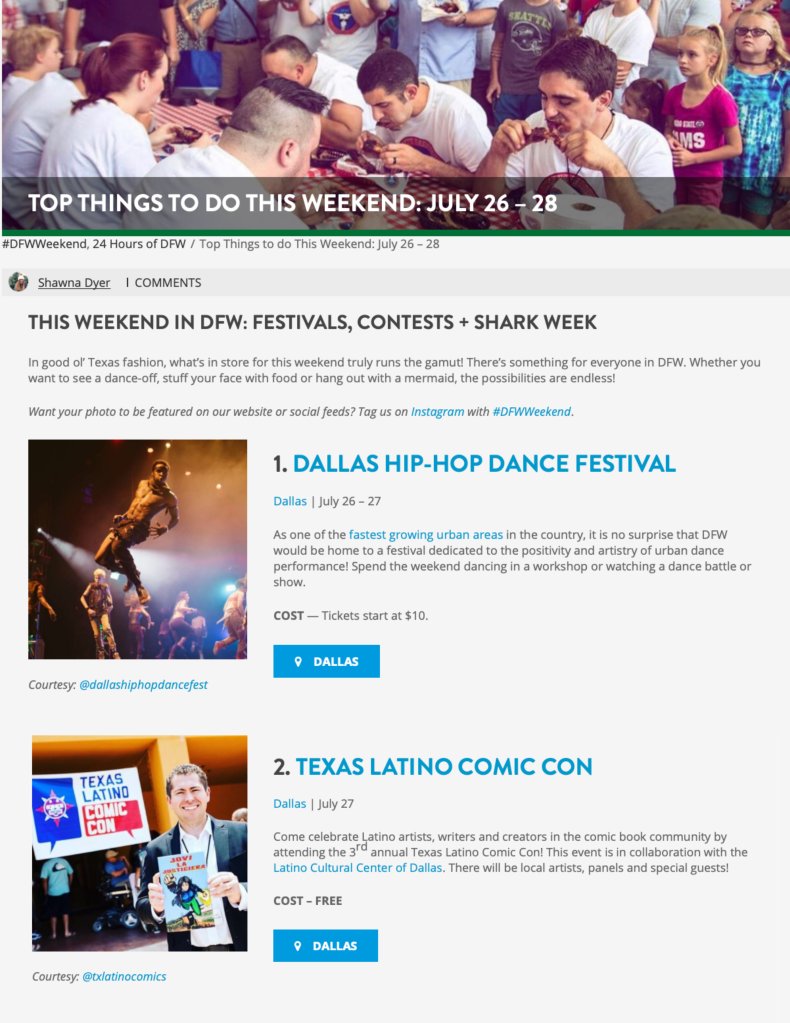
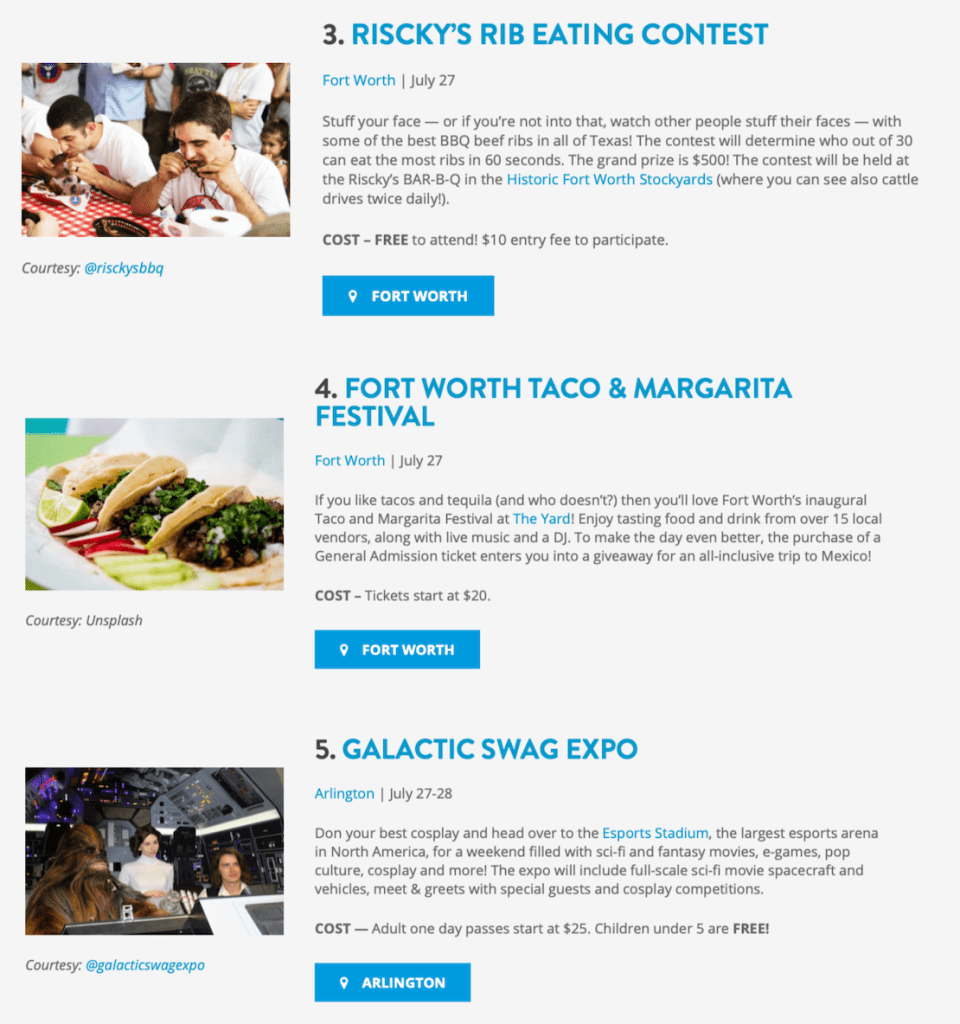
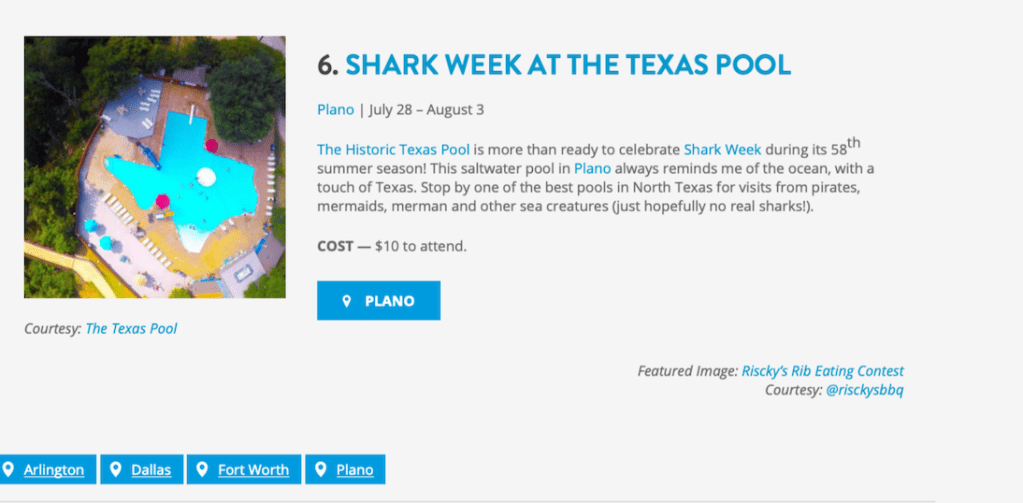
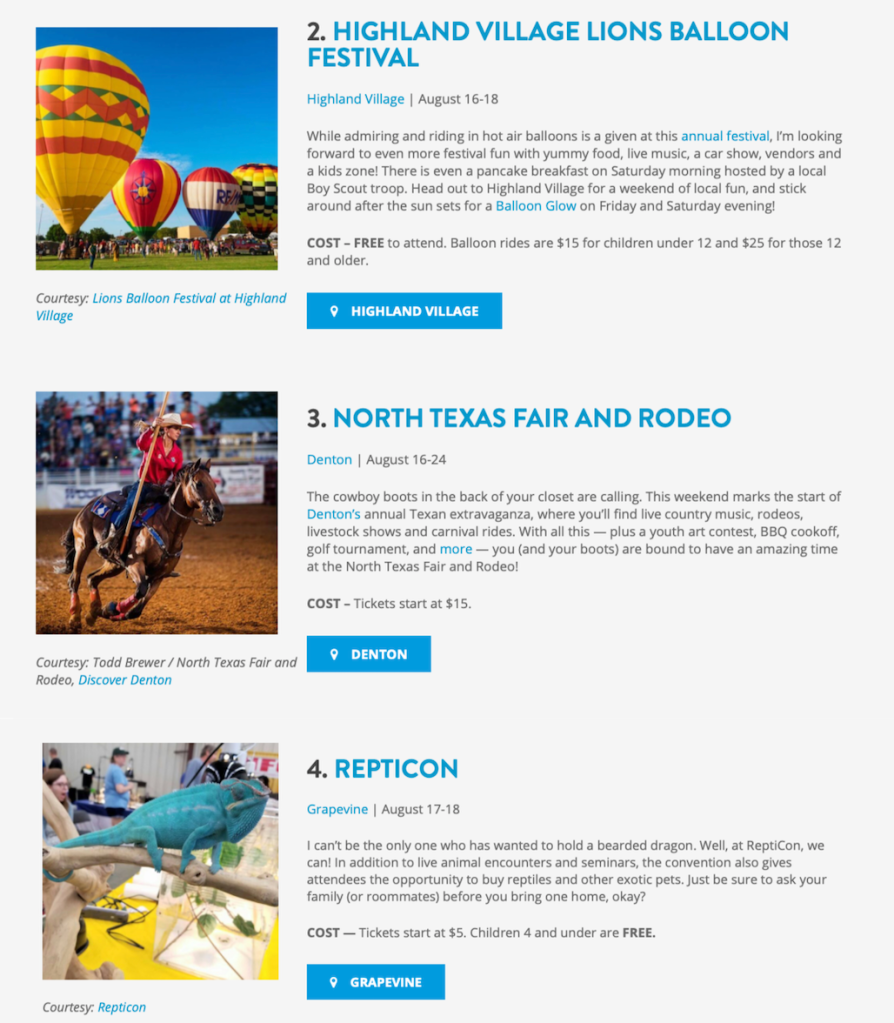
I interned at VisitDFW for the Summer of 2019. I spent most of my summer researching events in the DFW area and finding what was worthy to travel to the area for. I also helped to source images for the articles I wrote.



Brand Voice Analysis
Bacardi Rum begins its origin story as a tale of the Bacardi brotherhood in Cuba and overcoming the odds of fighting for independence from Spain, inviting Americans to Cuba for lavish parties during Prohibition, and the exile of the Bacardi family from Cuba. It is a company 156 years in the making, beginning in 1862, and it is still family owned. The brand takes pride in its symbol of a bat, because bats bring good fortune. It is now the largest privately held, family owned spirits company in the world. There are two main consumer groups that Bacardi Rum targets. A lot of ads over time and the current website make reference to the heritage of the brand, high class living, sophistication, and tradition. On the other hand, the brand has a history of advertising a different lifestyle, using the word “playboys” and showing women’s tramp stamps and midriffs on print ads. An implicit theme is nostalgia. Currently, there is a big push for Bacardi on the music scene, as it sponsors stages at music festivals, as well sponsoring music artists such as Major Lazer, Liam Payne, Cardi B, and Swizz Beatz.
Since Bacardi Limited, the parent brand to Bacardi Rum, is the largest privately held, family owned spirits company, I decided to compare Bacardi Rum to brands not owned by Bacardi Limited. The brands my groupmates used are Cîroc Vodka, Jack Daniel’s Whiskey, and Absolut Vodka. Cîroc and Jack Daniel’s both have pages on their website dedicated to their origin stories, just like Bacardi. Absolut has a page called “our story” but it is about how the vodka is made, not how the company was founded. Cîroc and Absolut are regarded as “premium” liquors, which is similar to wording used to describe Bacardi. Based on their Instagram accounts, Cîroc and Absolut are targeting similar consumers to Bacardi, using famous musicians and rappers to promote their brands. Jack Daniel’s, on the other hand, is sticking to its rustic, traditional, American roots to promote its brand on social media. These other brands do not appear to be as versatile as the Bacardi brand.
The official tagline for Bacardi is “Live Passionately. Drink Responsibly.” Advertising, social media, and the Bacardi website make use of the following words frequently: consistent, high quality, excellence, enjoyment, gold, richer, premium, legendary, heritage, freedom fighter, refugee in America, family-owned, fate, prohibition, Cuba, and untamable. The website conjures up feelings of nostalgia. It seems that advertising for Bacardi has always been running two parallel storylines– one includes decadence and high class, while the other makes use of the “Bacardi Party” and “playboy” lifestyle. These two different stories still seem to be utilized by the brand, because their social media accounts portray a different lifestyle than their website. The current Bacardi Instagram feed is obviously trying to each a hip, younger, more modern crowd, as the bio of the brand’s Instagram account is “BACARDÍ presents the Sound of Rum.” The social media accounts imply that Bacardi is for the party- and concert-goer, that Bacardi will make you famous. In recent commercials, Bacardi has made use of music and dancing. One particular commercial appears to be shot in the streets of Cuba with many people dancing and there is no voiceover or copy at all.
There seem to be different tones used for the brand on different platforms. The tone and content used on social media postings is heavily related to music and being the life of the party. Bacardi even hosts its own concerts at the Casa Bacardi and posts pictures of those events on Instagram. It is interesting to note that when Bacardi posts pictures of people, most of them are black, and a few are white. There is not much mention of Cuban heritage on the brand’s social media postings. The tone and content of website and advertising is to embrace tradition, to incite nostalgia, and is much more serious than Bacardi social media. There is no mention of music or musicians on the Bacardi Rum website, which is odd to me because of how prevalent it is on Bacardi social media.
The newsroom for Bacardi is on the Bacardi Limited website, which encompasses the entire parent company. Recent postings in the news room boast about accolades the company has received such as 6thyear in a row as one of Forbes’ “Most Reputable Companies in the World” and many others. According to the online newsroom, Bacardi highlights the importance of Corporate Responsibility with programs such as women’s empowerment.
Bacardi appears to have two distinct target audiences. The first audience is a seemingly white, middle aged, decadent middle to upper class infatuated with tradition, heritage, and skirting the rules a little bit. The second audience encompasses much younger people of color who are very involved with music and having fun. It is apparent that the initial target audience was and still is middle to upper class men and women of high sophistication. At the same time, I was able to find vintage ads making use of the “playboy” lifestyle. The newest Bacardi Rum campaigns focus on reaching new, much younger consumers. The brand is utilizing major musicians and djs such as Major Lazer, Liam Payne, Cardi B, and Swizz Beatz on Instagram and Twitter. The company is also sponsoring concerts and music festivals. In recent years, heritage has been downplayed and house parties and modern music have been used to seduce consumers on social media.
If Bacardi Rum were portrayed during the days of its inception, the person to describe the brand would be an older, handsome, rugged, and yet refined Cuban man. In the 1900s, Bacardi Rum would be a 30-35-year-old man in a penguin tail tuxedo or a flapper woman with pearls around her neck smoking a cigarette, having just arrived in Cuba from America to escape Prohibition and have unadulterated fun. Currently, Bacardi Rum can be best categorized as an early to mid 20s man or woman of color living in America who is deeply involved in the music scene and has some sort of clout over others in that age group. The current person portraying Bacardi would also be very in tune with social issues.
The brand voice for Bacardi Rum is very effective in its origin story, advertising campaigns, and even in the distinctness of its packaging. Bacardi’s advertising in general works extremely well because it is the only brand that comes to mind when I think of rum. I had to Google “popular rum brands” just to see who its competitors are and only then was I reminded that the only other brand of rum I know of is Captain Morgan, but I could not recall it until I saw the name in writing. It is clear that Bacardi has a history of targeting those who go against societal norms, or those who want to believe they go against societal norms. However, even though I said I think the branding is effective, I think the brand needs to choose one storyline for advertising and social media and run with it. I understand that something like alcohol can be targeted to many different audiences, but it seems that the parallel stories Bacardi is making use of do not fit together well enough to be cohesive.
News Release
Spice company unveils multiple facets of expansion
Five chefs from Netflix special bring products to life at annual sales event
(SEATTLE, September 17, 2018) –
Kendra Willis, CEO of Unique Spices, Inc., announced today that the company will be expanding its product lines and adding new team members from around the world.
At the company’s annual sales event earlier today at the Seattle Convention Center, Willis detailed 26 new spice blends, a new line of 11 sauces, expanding into new global markets and hiring a vice president for international dealings.
“We think our spice blends are the best. Scratch that – we know our spice blends are the best, which is why we are so excited about our newest organic spice blends, as well as adding a line of smooth, savory sauces to our brand,” Willis said in her opening statement at the annual sales event. “They are so perfect for us as we enter into Australia, the United Kingdom, France and Germany.”
These 26 new spice blends now make a total of 100 spice blends for the company. Willis says she believes “the company has spices down to a science now,” proven by receiving the “Golden Spoon” award for excellence by the New York Cuisine Association, which makes exploring into other product lines a worthwhile challenge. The sauces come in 11 different flavors and will be sold by the jar.
“My husband is from Australia, so it is so great to get into that market and collaborate with his heritage,” said Willis. “We have been wanting to get into the European market, but the timing just never seemed to line up perfectly. Now is the right time.”
To understand the countries Unique Spices, Inc. is entering into, Willis has hired a country manager for each new location to help build and maintain the brand.
Steve Lewis was announced as the first international vice president for Unique Spices, Inc. He has experience working in the spice industry as a vice president for a competitor, McCormick, in Latin America. He will begin next month.
“Steve Lewis is the perfect man for this position. As a former member of the McCormick team, he knows his way around a spice rack,” said Willis.
Willis says her company’s direct selling model creates a better environment for her team and her customers. The efficiency of the model is proven in Unique Spices, Inc.’s annual sales event being attended by 8,000 sellers – the largest number of attendees to date for the event, she says.
“There’s nothing like the personal touch of having a friend or family member come to you and say, ‘Hey, try this new spice that I’m selling. So, you try it because you trust your friend,” said Willis.
To help bring the new spices and sauces to life, five chefs from the Netflix show “Chef’s Table” created multiple dishes for sellers and customers to sample. Willis’s most recent cookbook, Memorable Tastes, was also for sale at the event.
About Unique Spices, Inc.
Unique Spices, Inc. was founded in 2005 by Kendra Willis. The company now has more than 14,000 employees in the U.S. and Canada. As of today, the company now has 100 spice blends for various types of cooking and baking, including curries, desserts, exotic salt blends, barbeque rubs and ethnic blends. The company has received over 25 awards in competitions all over the U.S.
###
FOR MORE INFORMATION, CONTACT:
Shawna Dyer
Communications Manager
xxx-xxx-xxxx
Tweets:
- Who is excited to see which chefs from “Chef’s Table” will be joining us at Unique Spices annual sales event tomorrow? I can’t wait.
- My dreams of being the biggest direct spice seller are becoming more of a reality. We are launching in Europe and Australia as of today!
- Our future is looking even more… SAVORY. We just added 26 new spice blends and our first ever line of sauces.
- Our annual sales event was our best ever! We are so proud of all of the awards our spices have won. We already knew you loved us, but were amazed at the customer turnout.
- Are you already day dreaming about your tryptophan nap after Thanksgiving dinner? Make your meal beforehand taste even better with our new “Thanksgiving to Remember” gravy.
Media Kit:
- DVD of Kendra Willis’s speech at the Seattle Convention Center
- A fact sheet (because there is a lot of information here)
- Include a picture of Kendra Willis and Steve Lewis at the sales event
- Include pictures of the news spices and sauces
Speech
Event: an internal 5-year anniversary of Box Party at the Dallas Headquarters
A Party for Five Years of Box Party
Welcome to our biggest party yet: the five-year celebration of Box Party and our partnership with the Birthday Party Project. As you know, I’m Adrián Beltré. Maybe better known as the man who works more tirelessly now that I’m considered retired than I ever did while being a professional baseball player.
It’s great to see you again in the very room where we announced the grand opening of Box Party five years ago. Five years! A lot has changed since then. But, one constant is our commitment to bettering the lives of those around us. To celebrate Box Party, I’d like to talk for a moment about how it all started, where it is now, and our plans for the future.
Years ago, my wife, Sandra and I were getting ready to go out on a date night in Dallas. We set out Monopoly and Jenga on our kitchen table, along with the list of our phone numbers and other emergency contacts. We almost felt bad leaving our children and the babysitter with such a sad setup for the night. That’s when it dawned on me: our children and whoever is taking care of them deserve better. Nights like these deserve personalization.
Thus, the creation of our first product, The Babysitter Box, was born. And that truly was just the beginning.
The ability to create a themed night and choose what games, snacks, crafts are involved makes leaving our children easier and makes us feel better knowing they will be having fun while we’re away from them. That peace of mind is unparalleled as a parent.
When I began dreaming up Box Party, I could have never imaged how much it would grow in just five years. I know that when we announced Box Party as our newest project, shortly after I announced my retirement from baseball, maybe some of you rolled your eyes and thought really? This guy again. Does he ever take a break? The answer is no. I’ve always wanted to give back to the community that has given so much to me. That’s why I take so much pride in being involved in the Texas Rangers Baseball Foundation, the Texas Rangers RBI program, the I Love Baseball program, and the Baseball Tomorrow Fund.
As a young boy growing up in the Dominican Republic, I was taught that baseball was the means I could use to give myself and my family a better life. I would practice for up to ten hours a day with the dream of becoming one of the greatest baseball players of all time. Growing up, my mother would say to me, cuando se le fija la mente, puede hacer grandes cosas, meaning when you set your mind to it, you can do great things. Her words are what I come back to when I need reminding of what all of this is about.
My childhood dream led me to where I am today. That’s why I think it is so vital to instill the same ability to dream in children all over the world, especially in my home country of the Dominican Republic. But, in planning my retirement, I realized there was a pattern in my philanthropic efforts focused in the baseball community. Although I knew I was helping a lot of children by using my platform of baseball, there are many other children who need our help. That is where The Birthday Party Project, as you know, an organization also based in Dallas celebrating the birthdays of children living in homelessness and transitional facilities, comes into play.
Driving home from Rangers practice one day, I heard a PSA for The Birthday Party Project on the radio. It got me thinking about what I could do to help this amazing organization. That was some years before Box Party was conceived. Naturally, I wanted to include an aspect of philanthropy to Box Party. When Sandra and I started looking at buildings for our headquarters, I noticed that The Birthday Party Project, which had been in the back of my mind for a long time by this point, was practically just down the street from the building we chose. It was a home run. Sorry! I may be retired now but I can’t resist using a baseball metaphor.
So, by now you must be wondering, how many boxes have we sold? I am happy to say that in the past five years, we’ve sold over seven million boxes nationwide. And how many birthday parties have we been able to host at our headquarters as well as donate to? More than one million birthdays. These numbers wouldn’t be possible if it weren’t for the work and dedication each of you contribute when you show up to work every day.
Without each of you, none of this would be possible. From the simple idea of a box for our children and their babysitter, we’ve made a big dent in the home delivery market, now shipping themed boxes for bigger events such as holidays, birthdays, presents, weddings, party favors, and the list goes on.
As we continue on this journey filled with parties in a box and bringing people joy, we’re going to be expanding our shipping capabilities from nation-wide to world-wide. Soon, people all over the globe will be able to celebrate events, holidays, birthdays, or even just a family game night at home without the hassle of planning it themselves. Besides shipping, we’re also expanding our donation capabilities. While a portion of each box will still be going to The Birthday Place Project, consumers will now have the option to donate a separate portion of the proceeds from their purchases to another approved philanthropic organization from a list on our website.
In honor of our birthday, we’ll be celebrating you, our employees, during the next week of work for a week-long party. Your hard work does not go unnoticed. A special five-year anniversary box will be delivered to your desk with a family- and friend-oriented theme, chosen with you in mind. Thank you for helping make us one of the best box delivery services in the nation. So, grab a piece of cake! You all deserve it. I can’t wait to see where our momentum will take us in the next five years.
Opinion Articles
The Price we Pay for Modernity
You are the face of whatever company you work for. Therefore, what you say anywhere, especially online, matters. Because reputations are on the line, it is obvious why employers want to keep tabs on who and what their employees are posting about on social media.
Although some people fear employee monitoring online and believe it to be overbearing, what you post online can reinforce why a company hired you in the first place and can positively impact your job. Careerbuilder.com found that during the hiring process, “more than 44 percent of employers have found content on a social networking site that caused them to hire the candidate.”
So, what if you just delete all of your accounts, so that your employer has no trace of your online activity? Well, that’s even worse. Careerbuilder.com stated that “57% of employers are less likely to call someone in if the candidate is a ghost online.” Nowadays, your social media accounts are a résumé updated in real time, because your social media accounts say a lot about you. It makes sense that employers want the ideals, values, and skills of their employees to match those of their jobs or careers.
If your social media accounts are a true reflection of the best parts of self, as they are intended to be, then it is not any more difficult to acquire and maintain a job or career than it was before social media existed.
Be yourself online. At the end of the day, you are going to want to work for a place that has the same moral beliefs as you. And if that is the case, then you should not be worried about what you post online because others will understand that is who you are, and they like who you are.
Employment in 2018 – The Big Brother We did not Predict
Imagine a person from your HR department following you around after hours and on the weekends. He or she joins you on your dates with your significant other and listens to every phone call you make. He or she reads every text and email you send. I think you and I agree that this is a nightmare of sorts.
So why should employers be allowed to monitor their employees’ social media accounts? They should not be able to is the correct answer. Social media is a means of extending interpersonal relationships. For employers to monitor our every action on the internet is the equivalent of a video camera recording every action we do even while off of work.
Monitoring everything an adult does while not even in the presence of the work environment is an invasion of privacy. Not only is it an invasion of privacy, social media monitoring has proven to have “the limited preventative effect of social media monitoring may not be worth the time and expense required for companies to do it,” according to S. Kumar in “Why Monitoring Employees’ Social Media is a Bad Idea” for Time.com. Social media monitoring is impractical because it keeps employees on edge about what parts of their personal lives they share online.
Kumar also pointed out that many people, mostly Millennials, will create fake, or burner, accounts to convince employers that what they post online is different and more appropriate than what they post on their real, personal accounts. Whether or not someone is posting all of his or her scandalous episodes online, they are all probably going to occur anyway, and actions travel by word of mouth as well.
Employers should focus their valuable time and money on how their employees are as human beings and teammates in the work place. Unless employees say something so ludicrous that it goes viral or is brought to the attention of employers, then it is probably a waste of effort to monitor online activity 24/7 when it more often than not comes up short.
Feature Article
Grab a cup of coffee and prepare to learn about Intersectionalism
“I’ve already had three cups of coffee today. You guys probably should too.”
Projecting in a loud, soothing voice, the professor crosses the threshold of the classroom and stands in front of the podium just as the clock hits 3:30 pm on a dragging Monday afternoon. Standing tall, making eye contact, and smiling widely, the professor calls roll. There is a clear power of authority.
Over the course of the semester, the professor reveals previous jobs and personal accolades: Military contractor for US Army Distance Learning Program, Corporate Communications and Field Public Relations professional at Northwestern Mutual, associate vice president at Mississippi College, vice president of Education at Edelman Agency, associate director of TCU’s Center for Career and Professional Development, Owner of KLindz Consulting firm, TED talk speaker, as well as completing a PhD this December.
The above list of life highlights is astounding for any professor, but even more so for Karen Lindsey. Why? She is a black woman.
(insert a picture of Karen Lindsey here)
Lindsey is confident, collected, cool. Her students greatly benefit from her as an instructor with many other life experiences.
There are a lot of women of the same demeanor who do not get the chance to reach such high-ranking positions. Fortune.com reiterates this sentiment by publishing an article about Ursula Burns, former CEO of Xerox. She is the only black woman to be the CEO of a Fortune 500 company, serving from 2009 to 2016. There are currently no black women holding such a title.
So, what does being black or a woman have to do with anything?
Well, everything, actually. They both do.
Being top ranking in the corporate world and now working in higher education, Lindsey has first-hand experience as to how black women are treated and affected by white, male-dominated working environments.
“I have been, and am, a black woman who is in leadership,” said Lindsey. “All of those identities and how they intersected for me [are important]. I also think it’s very interesting that I have been in the corporate world as well.”
Her identity, and the lack of understanding surrounding it, have led her to focus on Patricia Hill Collins’ Black Feminist Thought and Kimberlé Crenshaw’s intersectionality as the framing of her research for her dissertation. Her research involves qualitative studies on how leadership identity is created by black women in executive and presidential positions within the corporate world and higher education.
Merriam-Webster defines intersectionality as “the complex, cumulative way in which the effects of multiple forms of discrimination (such as racism, sexism, and classism) combine, overlap, or intersect especially in the experiences of marginalized individuals or groups.”
Even white women who experience discrimination in the workplace, may not see or relate to what black women go through. “I think that’s the way it is for most people who ask me, ‘well, why are you so angry?’ It’s because you don’t live it every day,” says Lindsey.
The theory for the phenomena of black women not being respected in positions of power is known as the Role Congruity Theory. Black women are often boiled down to a stereotype, according to the theory.
Recounting her own experience and having conducted research, Lindsey believes “there’s this idea about how a black woman in higher ed[ucation] is supposed to look. So, you’re not supposed to be fashionable, yikes! You’re not supposed to be attractive. You are supposed to look more Afro-centric. Some of [the women Lindsey’s interviewed] have changed their appearance to fit the mold to stay in their roles. So much is at stake here.”
“Yikes” is right.
Symbolic annihilation, the concept of marginalized groups not being portrayed in mass media, was also made reference to. Lindsey discussed her career dreams during college, detailing how she wanted to be a reporter like Barbara Walters or Katie Couric, because no one who looked like her was on television.
In Women and Gender Studies, there is a concept of a feminist hierarchy, addressed by black women through the womanist, a notably black feminist, movement. Lindsey referenced this theory when she realized her white female friends did not see how she was being treated by white men in the corporate setting: “I walked around for years thinking I was crazy – that I was overly sensitive.”
(insert a picture of the women she is interviewing for her dissertation)
What’s next?
Through all of these tribulations, Lindsey is still hopeful for the future. “My hope is that my research will spur on a new generation of not just black women, but white women as well, to be more informed about what women might be dealing with. So that all of us can understand each other’s issues. That no one of us is greater or better, we are just different.”
The timing could not be better for Lindsey to be conducting her research. If it were not for her past experiences, she would not have the knowledge and expertise to shed light on this topic that is often found hard to talk about.
“There is a place for all of our voices,” Lindsey says. “To me, there is power in that connection, in an ally. You don’t have to be me to understand. You don’t even have to agree with me to understand. But you have to know that to me, it’s real. Perception is reality.”
 Shawna Rose Dyer